Peptide Website SEO: How Brands Compete for Buyer-Intent Searches
Written by Peptide Growth Agency · Editorial standards
TL;DR
Peptide website SEO for buyer-intent searches: map keywords to page types, match intent, build internal links and schema so brands compete and convert.
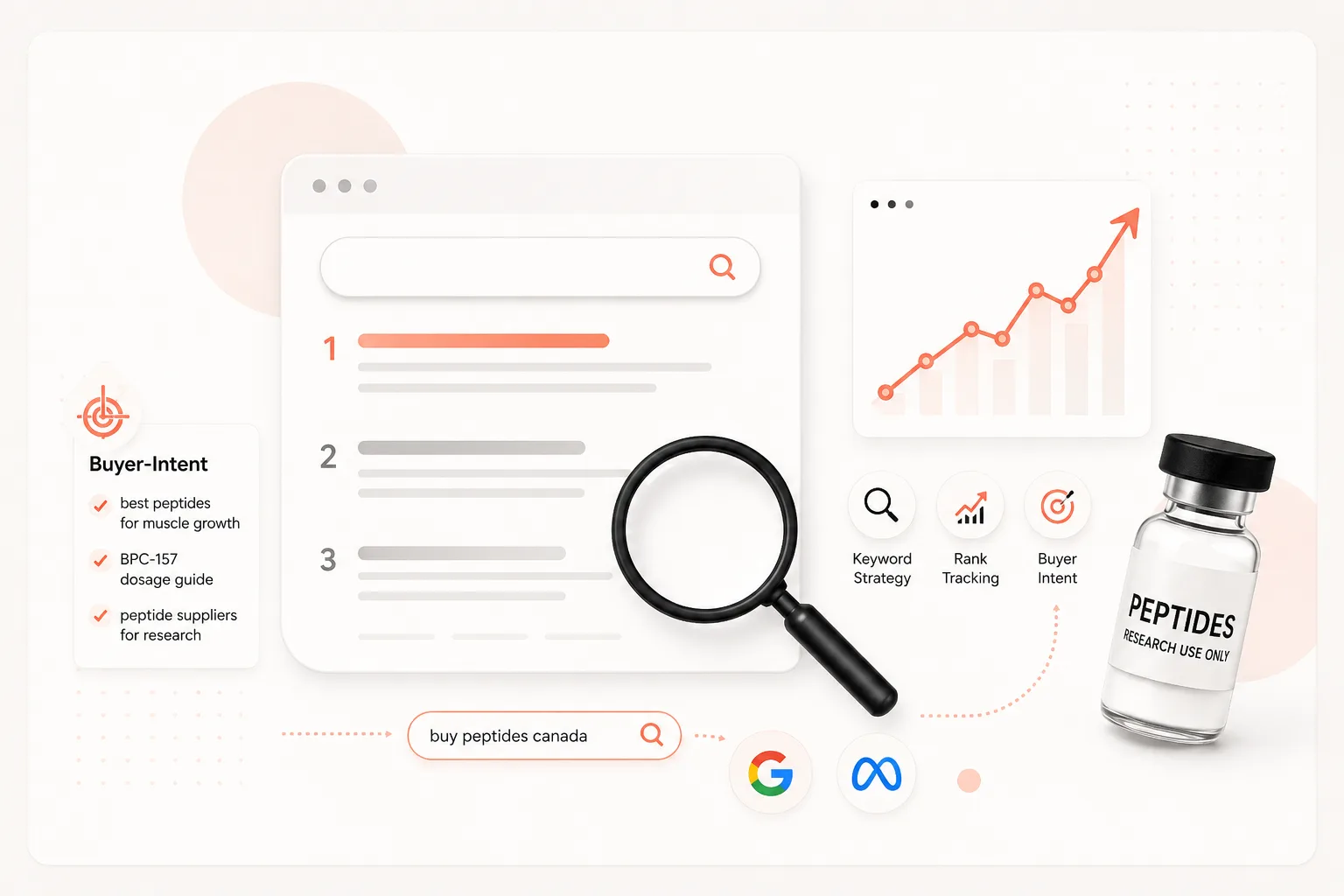
Peptide website SEO is won by matching, not volume. The brands that compete for buyer-intent searches are the ones that take each query a near-decision searcher types, send it to the page that best answers it, and connect those pages with clean internal links and structured data. This guide shows brand owners how to build that mapping.
One framing note: Peptide Growth Agency helps brands market and rank. We do not sell peptides. Buyer-intent phrases like "best peptide website" or "peptide supplier" are searches your brand competes for, and our role is making your pages the most useful, compliant answer.
Start by separating intent, not keywords
Keyword lists are not strategy. Intent is. Group your terms by what the searcher is trying to do:
- Informational intent - "what are peptides," "peptide quality standards." The searcher wants to learn.
- Commercial investigation - "best peptide website," "peptide brand comparison." The searcher is evaluating options.
- Transactional or buyer intent - "peptide supplier," "where to buy peptides." The searcher is close to acting.
- Navigational intent - branded searches for your company or a competitor.
Each group wants a different page. Forcing a transactional searcher onto a 2,000-word explainer, or an informational searcher onto a bare product page, is the fastest way to lose the ranking and the visitor.
Map each intent to a page type
This mapping is the core of peptide website SEO.
- Informational maps to guides, explainers, and pillar articles. These build topical authority and feed internal links downstream.
- Commercial investigation maps to comparison pages, category hubs, and well-structured destination pages that demonstrate quality and selection.
- Transactional maps to product, category, and conversion-focused landing pages with clear trust signals and a clean path to action.
- Navigational maps to your homepage, about, and brand pages.
When the page format matches the goal, engagement rises and search engines reward the match. Our peptide SEO service is built around this exact intent-to-page architecture.
Build internal links that move authority
Internal linking is how authority earned by one page reaches the pages that need to rank for buyer-intent terms. Most peptide sites underuse it.
A few rules that work:
- Link from authority to opportunity. When a strong informational guide ranks well, link it to the commercial pages you want to lift.
- Use descriptive anchor text. Anchors should describe the destination, not say "click here."
- Keep clusters tight. Pages within a topic cluster should link to each other so search engines see the full scope of coverage.
- Avoid orphans. Every important page should be reachable from at least one other relevant page.
For B2B and reseller searches, intent layers differently. Our peptide wholesale SEO playbook covers how buyer intent shifts when the buyer is another business.
Use schema to make intent machine-readable
Structured data does not directly hand you a ranking, but it removes ambiguity about what a page is. That clarity helps eligibility for richer results and helps generative and answer engines summarize you correctly.
Prioritize:
- Organization schema for brand identity and trust.
- Product schema on transactional pages, used accurately and compliantly.
- Article schema on guides and explainers.
- FAQ schema where you answer real questions concisely.
Combined with clear headings and concise answers, schema makes your pages easier to understand for both classic and AI-driven search.
On-page matching for buyer-intent pages
A buyer-intent page has to satisfy the query above the fold and reassure quickly. The pattern that converts:
- A headline that mirrors the search intent.
- A direct answer or value statement in the first two sentences.
- Visible trust signals: sourcing transparency, quality information, credible references.
- Clear comparison or selection logic for commercial-investigation searches.
- A clean, low-friction path to the next step.
The trust layer is doing real SEO and conversion work at the same time. We unpack it in best peptides website searches: what buyers expect, and the technical and content factors behind ranking in what makes the best peptide website rank in 2026.
Win the long tail before the head terms
Head terms like "best peptide website" are valuable but crowded. Newer brands compete faster by capturing the long tail first: specific, lower-competition buyer-intent phrases that signal a searcher who knows exactly what they want.
Long-tail buyer-intent terms convert well because they are precise. Someone searching a narrow, specific phrase is usually further down the decision path than someone typing a broad head term. Build pages that answer these precise queries directly, then let the topical authority they accumulate support your push toward the more competitive head terms.
A practical sequence:
- Identify clusters of specific buyer-intent phrases around each category.
- Create or strengthen the pages that answer them precisely.
- Interlink those pages with the broader category and pillar pages.
- Use the authority earned there to compete for the head term over time.
This bottom-up approach builds momentum where competition is thinner and revenue intent is high.
Answer engines and GEO
Buyer-intent search no longer happens only in classic results. Generative and answer engines increasingly summarize options for searchers, which means your pages need to be easy for a machine to read and quote.
Generative engine optimization is not a separate discipline; it is clarity taken seriously:
- Lead key pages with a concise, direct answer.
- Use specific, entity-rich language so your brand and categories are unambiguous.
- Keep headings descriptive and scannable.
- Maintain accurate schema so machines parse your pages correctly.
Pages built this way tend to perform in both classic and AI-driven search, which is exactly where buyer-intent traffic is heading.
Stay inside compliant ground
Buyer-intent SEO in this niche tempts brands to overpromise. Resist it. Ranking gains built on unsupported outcome claims are fragile and risk platform action. Compete on usefulness, transparency, and structure instead.
This is also why we treat phrases like "best peptide website" as topics to rank for, never as claims that anyone sells a guaranteed result. For the broader compliance picture across health-adjacent search, see SEO for peptide brands in a YMYL niche.
Measure intent, not just traffic
Track the funnel by intent stage:
- Rankings and impressions for buyer-intent terms specifically.
- Click-through rate on commercial and transactional pages.
- Engagement and dwell time by page type.
- Internal links added per month.
- Organic conversions into qualified inquiries or sales.
If informational pages rank but buyer-intent pages lag, your internal linking or page mapping is the gap. If buyer-intent pages rank but do not convert, revisit the trust and on-page layer. Watching the funnel by stage keeps you from optimizing the wrong thing.
A quarterly review also helps. Search behavior shifts, new buyer-intent phrases emerge, and competitors change their pages. Reassess your intent mapping on a regular cadence: confirm that each high-value query still points to the right page type, retire pages that no longer match how people search, and create new ones for intents you have started to miss. Strategy that is set once and forgotten slowly drifts out of alignment with the searcher.
For brands building this system from the ground up, our peptide marketing agency work connects SEO to the rest of the growth engine, so the traffic you earn flows into email, retargeting, and the wider funnel instead of leaking away.
Bottom line
Peptide website SEO is a matching problem. Sort searches by intent, send each to the page built to answer it, connect those pages with deliberate internal links, and make the structure legible with schema. Do that compliantly and you compete for the searches that actually drive revenue.
If you want a clear map of which buyer-intent searches your brand can realistically win, request a strategy audit and we will build it with you.