How to Start a Peptide Brand in 2026 (Step-by-Step Guide)
Written by Peptide Growth Agency · Editorial standards
TL;DR
Learn how to start a peptide brand in 2026 with a step-by-step guide to positioning, sourcing, compliance, branding, website, and launch marketing.
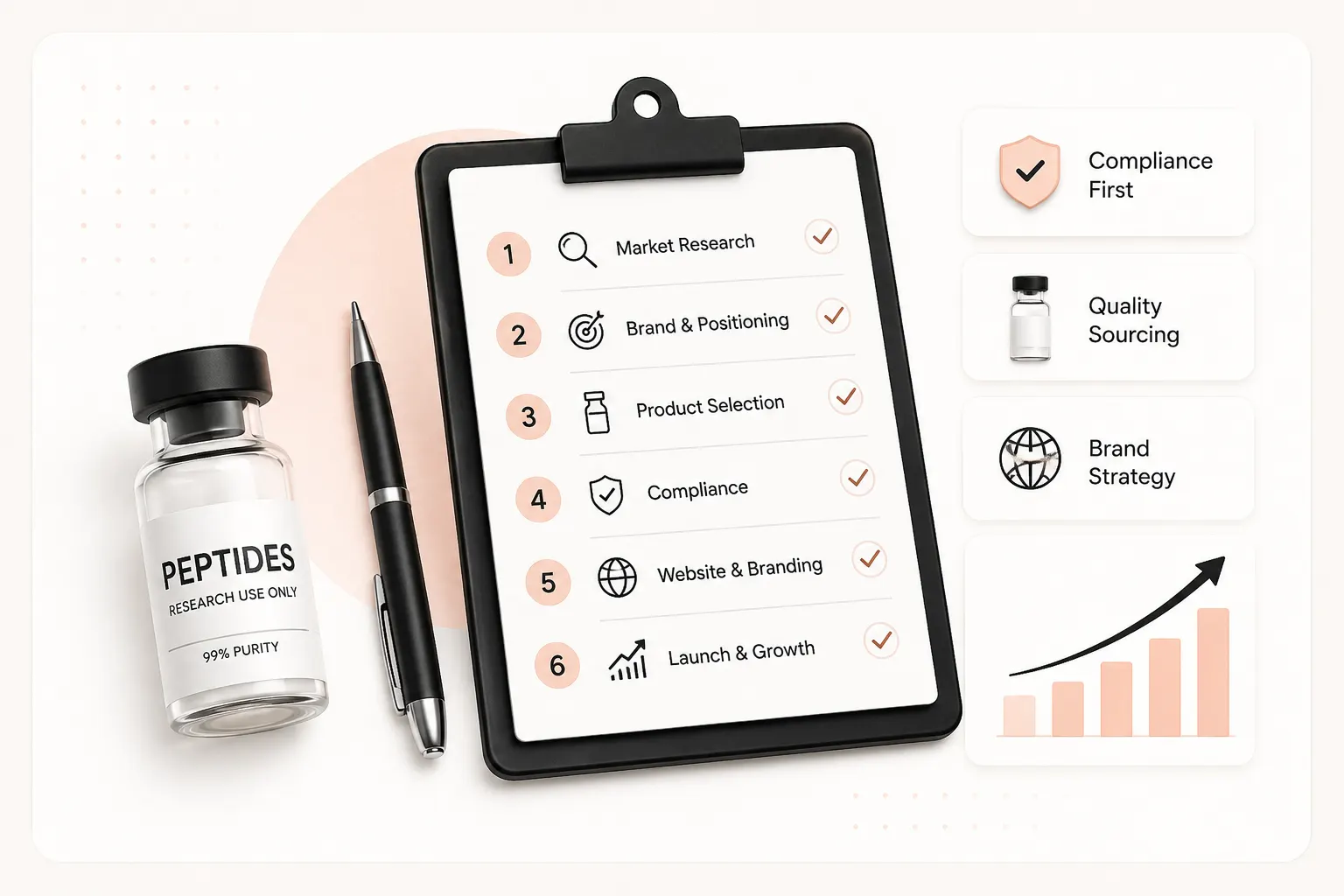
Starting a peptide brand in 2026 comes down to seven stages: sharpen your positioning, secure sourcing or manufacturing, build a compliance foundation, develop branding, launch a conversion-ready website, run compliant launch marketing, and scale what works. The brands that succeed treat compliance and clarity as growth tools, not obstacles. This guide walks through each stage in order, with deep-dive links where a topic deserves its own playbook.
One note on scope: Peptide Growth Agency helps brands with marketing, websites, SEO, and compliant copy. We do not sell peptides. "How to start a peptide brand" is a search-intent topic our clients compete for, and this guide is written to help founders build responsibly. Nothing here is legal advice; the regulatory steps below require qualified counsel in your market.
Stage 1: Positioning and market fit
Before you source a single vial or register a domain, decide exactly who you serve and why a buyer should choose you. Positioning is the cheapest and highest-leverage decision you will make.
Most new founders skip this and compete on price, which is a losing game in a crowded category. Strong positioning answers three questions in one sentence: who is this for, what category are they buying, and what makes you the credible choice.
- Pick a clear audience: research-focused buyers, wellness-oriented consumers, clinics, or B2B accounts. Each needs different messaging and a different site.
- Decide your differentiation: documentation quality, supply consistency, education, or brand experience.
- Validate demand with real search data before committing inventory, so you build around terms people actually use.
If you are unsure whether the demand is there, the category data is a good starting point. Our overview of peptide industry statistics shows where attention and growth are concentrated, which helps you choose a defensible niche rather than chasing the whole market.
A useful test for your positioning is whether you can say it in one plain sentence without using the word "quality." Everyone claims quality, so it differentiates nothing. Strong positioning names a specific buyer and a specific reason to choose you - for example, a research-focused audience that values documentation depth, or a wellness audience that values a premium, educational brand experience. The narrower and more honest your positioning, the easier every later stage becomes, because your branding, website, and marketing all flow from the same clear decision.
Stage 2: Sourcing and manufacturing
With positioning set, decide how you will actually get product. This is where many founders stall, because the options carry very different cost, control, and timeline trade-offs.
There are three broad paths:
- Private label: a supplier produces under your brand. Fastest to market, lower upfront control over formulation.
- Contract manufacturing: more custom, higher minimums, longer lead times, more control.
- Distribution or reseller models: lowest barrier, lowest margin and differentiation.
For most first-time founders, private label is the practical starting point because it lets you focus energy on brand, compliance, and marketing while a partner handles production. The catch is that your supplier becomes part of your quality and reputation, so vetting is non-negotiable.
The full breakdown of how to evaluate this path is in our deep dive on private label peptides, and the supplier selection process - including a vetting checklist and the exact questions to ask - is covered in our guide to peptide wholesale suppliers. Read both before you sign anything.
Stage 3: Compliance foundation
This is the stage that protects everything you build afterward. Regulations around peptides differ significantly by country and by how a product is classified, and the rules are enforced not just on the product but on how you market it.
You do not need to become a regulatory expert, but you do need to build on a compliant foundation from day one.
- Engage qualified legal and regulatory counsel for your specific markets before you publish claims or launch ads. This is the one step you should never skip.
- Understand how your product is classified where you sell, since that determines what you can and cannot say.
- Keep all marketing claims documentable. If you cannot support a statement, do not make it.
- Avoid medical, disease, cure, or guaranteed-outcome language entirely, including in testimonials and social content.
Compliance shapes your copy, your site, your ads, and your email. The brands that treat it as a creative constraint rather than a blocker end up with clearer, more credible marketing. Our guidance on SEO for peptide brands in a YMYL niche explains why search engines hold this category to a higher trust standard, which makes compliant copy a ranking advantage, not just a legal one.
The most common and costly mistake here is building marketing first and bolting compliance on afterward. Rewriting a launched site, reshooting ad creative, and re-recording founder content to remove non-compliant claims is far more expensive than getting the framing right before you publish. Build the compliant foundation early and every later asset inherits it for free.
Stage 4: Branding and packaging
Now build the brand that carries your positioning. In a category where buyers are wary, a credible, premium identity does real work: it signals seriousness and reduces perceived risk.
Good peptide branding is restrained, not flashy. It communicates quality and documentation rather than hype.
- Build a visual identity that reads as trustworthy and premium, not like a generic supplement.
- Design packaging that supports compliant labeling and clear documentation references.
- Develop a brand voice that is confident and educational without crossing into medical claims.
- Keep messaging consistent from packaging to website to email, so the experience feels coherent.
This is where a specialist matters, because peptide branding sits at the intersection of design and compliance. Our peptide branding and packaging service is built specifically for this category, balancing premium identity with the constraints the niche requires.
Stage 5: A conversion-ready website
Your website is where positioning, branding, and compliance come together and where buyers decide whether to trust you. For most peptide brands it is the single most important asset, because it is the one channel you fully control.
A strong site does three jobs at once: it ranks, it builds trust, and it converts.
- Lead with clarity: who you serve, what you offer, and why you are credible, visible within seconds.
- Make documentation and quality signals easy to find, since this is what serious buyers scan for.
- Keep copy compliant and educational throughout, including product and category pages.
- Structure the site for search from the start, with a logical hierarchy and intent-mapped pages.
Before you build, work through our peptide website checklist so you do not miss the trust and compliance elements that buyers and search engines look for. If you want to understand what separates a top-ranking site from an average one, our breakdown of how to build the best peptide website to rank in 2026 is the companion piece. When you are ready to build, our peptide website design service handles the structure, trust signals, and SEO foundations together.
Stage 6: Launch marketing
With the foundation in place, drive qualified attention. The peptide category is a minefield for paid channels, so your launch plan has to respect platform rules from the first dollar.
A balanced launch usually combines a few channels rather than betting everything on ads.
- SEO and content: the durable engine. It compounds over time and is not subject to ad-policy whiplash.
- Paid acquisition: faster but tightly governed. Creative and copy must follow each platform's rules.
- Email: the highest-ROI channel for retention and repeat purchase once you have traffic.
Paid channels deserve special caution. Our guide to advertising peptides on Google and Meta and our playbook on how to market peptides without ad-policy issues cover the language and structures that keep accounts alive. On the retention side, set up the core flows from our piece on email flows every peptide brand should launch before launch, so traffic does not leak.
Because SEO compounds, it is usually the smartest place for a new brand to invest early. Our peptide SEO and peptide marketing agency services are designed to build that durable visibility while keeping every asset compliant.
A sensible launch sequence is to stand up SEO and content first so the durable engine starts compounding immediately, layer email next so no traffic leaks, and add paid acquisition last and carefully once your messaging and landing pages are proven. Launching paid before the site converts simply pays to send traffic to a page that loses it.
Stage 7: Scaling what works
Once you have early traction, scaling is about doubling down on what converts and tightening the system around it. Resist the urge to add channels for their own sake.
- Track which keywords, pages, and flows actually drive qualified inquiries or sales, and invest there.
- Expand your content cluster around the topics that are already ranking and converting.
- Improve conversion before you increase spend, since a better-converting site multiplies every channel.
- Strengthen retention and repeat purchase, which is where sustainable margin lives.
For a structured view of the levers that move revenue, our guide on how to increase peptide brand sales maps the highest-leverage improvements for an established brand. Scaling is less about doing more and more about removing friction from what already works.
The trap at this stage is shiny-object thinking - adding a new social platform, a new channel, or a new product line before the current system is fully optimized. Each addition splits your attention and rarely pays off as well as deepening what already converts. Discipline at the scaling stage is what separates brands that grow steadily from those that plateau after a strong launch.
A realistic timeline and budget
Founders often want a single number, but the honest answer is that it depends on your sourcing model and how much you outsource. What you can plan for is the shape of the spend.
- Upfront: inventory or minimum order commitments, compliance and legal review, branding, and website.
- Ongoing: marketing investment, content production, and platform or tooling costs.
- Reserve: a buffer for the long B2B and compliance cycles that this category tends to involve.
Budget for compliance and a credible website first, because cutting corners there raises costs everywhere else later. A cheap site that does not convert makes every marketing dollar more expensive.
Bottom line
Starting a peptide brand in 2026 is a sequence, not a gamble: position clearly, source carefully, build on a compliant foundation, develop credible branding, launch a conversion-ready website, market within the rules, and scale what works. Each stage has a deeper playbook linked above, and the brands that move through them in order avoid the expensive mistakes that sink rushed launches.
If you want a clear read on where your brand sits and which stage to prioritize next, request a strategy audit and we will map the gaps and the highest-leverage moves.